Part 2: The Talking Dilemma
by Michael French, MA, LPC
Hello. Welcome back. In Part One of this two‑part focus on communication, we looked at the challenges that come our way in how we listen to our partners and the people we care about. After I published Part One, I had a few moments where I failed in my attempt to listen to my wife — and one instance stuck out to me.
We were in the kitchen the other day. She was talking, and I was initially engaged in what she was saying. But then that awful “squirrel” moment happened. Right below me on the counter was that day’s mail. I glanced down, broke the line of connection, and she noticed it immediately. I’m really a single‑tasker in most things, and trying to look at the mail and listen at the same time becomes almost impossible for me. The work of listening well continues — a couple steps forward, some steps backward.
Now, onto Part Two.
Today, we’re turning to the other side of the equation — how we talk, how we use our words, and how those words shape connection or conflict.
If we’re honest, most of us don’t always do great with what comes out of our mouths. And in the last several years, we’ve added different channels for expressing what comes out of our minds: texts, emails, emojis, and even short videos we send to each other. Who would have thought emojis would play an important part in the talking game? Words matter, whether spoken or typed, and they can either build bridges or burn them down. Even our choice of emoji can be perceived in different ways.
I once heard that the average woman speaks somewhere around 13–15 thousand words a day, while the average man lands closer to 12 thousand. For some of us guys, I’m convinced the number is even lower. I see this play out all the time in my counseling work. When couples fill out their intake forms, women often give me a full paragraph — sometimes several — just to answer a question like, “What are some presenting issues bringing you to therapy?” They offer rich detail, context, emotion, and nuance. It gives me a lot to work with.
Men… well, men tend to take a different approach. There are always exceptions, but more often than not, their answer to that same question is something like, “communication issues” or “marriage problems.” That’s it. No elaboration. No specifics. Just a broad category that could mean a hundred different things. It doesn’t give me much to work with, but it does tell me something important: how we talk is often underdeveloped, under‑practiced, and under‑examined.
And that’s why Part Two matters.
Communication Noise
Information Noise
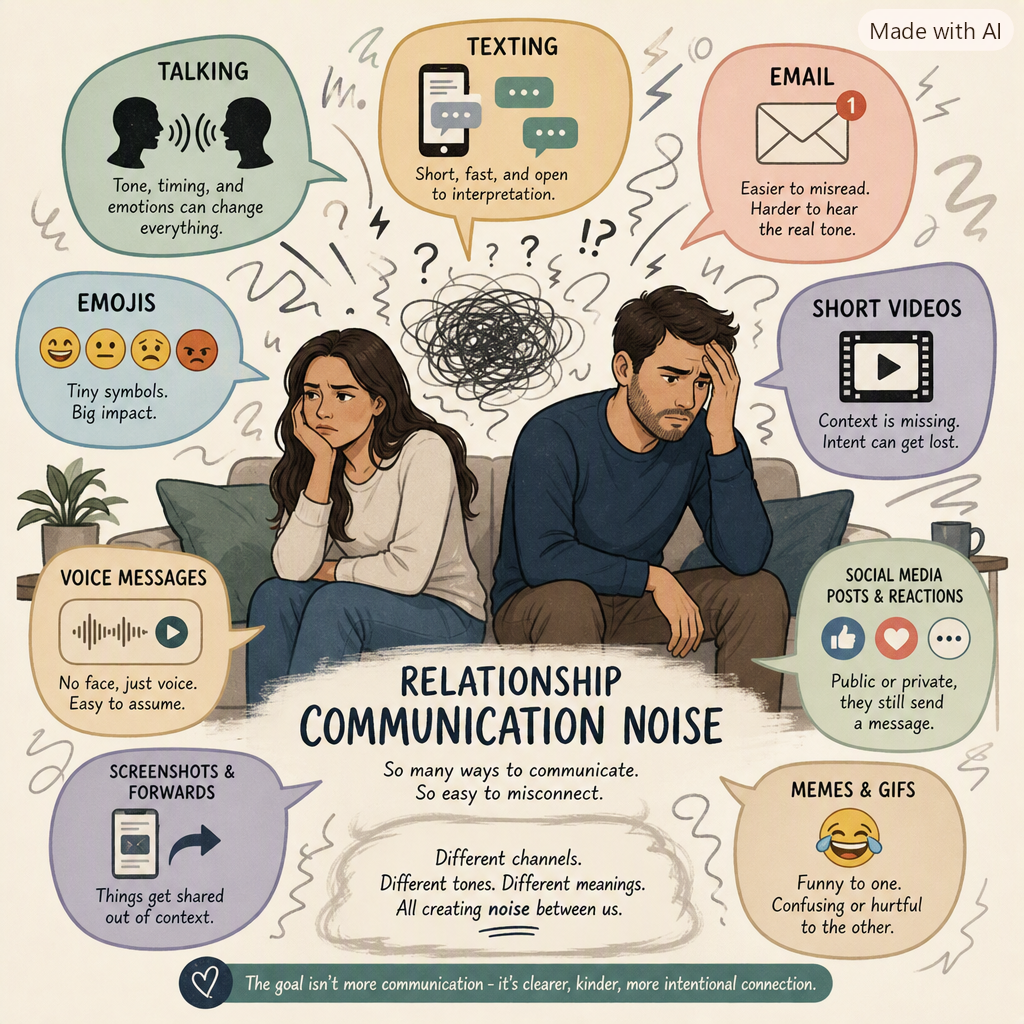
The illustration above shows just how many different ways our modern world communicates — and it’s a lot. Technology has given us more channels, more symbols, and more ways to express ourselves than we actually need. With every new option comes another layer of potential noise.
First, let’s look at what we say — and how we say it. Content today floods our social media feeds, TVs, and streaming platforms. We have more ways than ever to express ourselves, but if we’re not careful, all these methods can drown out the truth of what we’re trying to communicate.
The receiver can easily misunderstand if we’re not clear, and even well‑intentioned messages can get lost in translation. Every channel — whether it’s a text, an email, an emoji, or a short video — carries its own tone and potential for confusion.
All of these options have validity, but they also create noise. And when noise fills our communication, clarity suffers. The goal isn’t to eliminate these tools; it’s to use them wisely — to make sure our words, in whatever form they take, still carry grace, truth, and connection.
Sometimes we say too much. Over the years, I’ve received emails from clients, colleagues, and friends — messages that go on for pages, sometimes as one continuous train of thought. A few had no sentence breaks at all, just a stream of words tumbling forward. That same pattern can show up in conversation: nonstop talking, rapid‑fire words, no pause for breath. For the listener or reader, the translation of all that might be a feeling of being overwhelmed.
Those of us who love to talk can overdo it. Our partner gets lost because so much information is coming at them. The stereotype version? Someone calls you, starts talking, and never stops. You could set the phone down, run an errand, come back, and they’d still be going — completely unaware you ever left. It’s the endless train of word‑cars with no caboose. Exaggeration? Maybe not. I’m guessing you’ve experienced that at least once.
I have realized why some of us may go long winded. It may come out of a place of lonliness and the desire to be heard. It’s a longing that what we are saying matters. I’ve compiled a couple of lists for this piece. They are not tied to one bit of research but come from an array of counseling modalities such as attachement theory, family systems theory and Gottman Method Communication among others. Here are 5 reasons why some of us might have this gift of gab.
1. Anxiety Drives Verbal Overflow
For many, talking becomes a way to manage internal anxiety. The more anxious they feel, the more words spill out. Speech becomes a self‑soothing mechanism — a way to keep control, avoid silence, or prevent uncomfortable emotions from surfacing.
2. Fear of Being Misunderstood
Ironically, the same fear that makes some people say too little can make others say too much. They over‑explain, repeat themselves, or add unnecessary detail because they’re trying to guarantee clarity. The result is often the opposite: their partner feels overwhelmed.
3. Difficulty Regulating Emotions
When someone feels strongly — excitement, anger, fear, passion — their words can come out fast and unfiltered. Emotional intensity can override pacing, leading to long monologues, tangents, or rapid‑fire speech.
4. A History of Not Being Heard
People who grew up in environments where they were ignored, dismissed, or talked over often compensate by talking more. They’ve learned that if they don’t say everything now, they may not get another chance. Their talking becomes a fight for space.
5. Habitual or Personality‑Driven Patterns
Some people simply process externally. They think out loud, connect dots verbally, and use speech as their primary way of organizing thoughts. It’s not intentional overwhelm — it’s how their brain works. Without awareness, though, this can flood a partner who processes more quietly.
The Quiet Ones
On the other hand, some of us say far too little. How many times has our partner overanalyzed a single word in a text we sent — that infamous “OK”? “OK.” “Ok.” “OK…” “Okay.” Each version feels different, doesn’t it?
When asked how we’re doing, many of us default to one‑word answers: “Good.” “Fine.” “Okay.” Surface‑level, short, safe. Our partner ends up having to pry for more, trying to deepen the conversation that we’ve kept shallow — a sentence women have had to use on their talking‑shy men:
“I just want to know what you’re thinking or feeling.”
And I know from my experience as a husband, my answer at times has been the commonly used phrase many of you can relate to:
“I don’t know.”
Let’s not forget the shortened text version — IDK — or the emoji:

Both extremes — the flood and the drought — create noise. One overwhelms; the other starves. Healthy communication lives somewhere in between: enough words to connect, but not so many that we lose meaning.
Here are a few reasons what we say is often seen as too little.
1. Fear of Conflict
Many people hold back because they’re afraid their words will start an argument, disappoint someone, or create tension. Silence feels safer than risking a reaction they don’t know how to handle.
2. Not Feeling Emotionally Safe
If past attempts at sharing were met with criticism, dismissal, or anger, they learn to keep things short. A one‑word answer becomes a shield: “If I don’t say much, I can’t get hurt.”
3. Difficulty Identifying Their Own Feelings
Some people genuinely don’t know what they feel in the moment. They aren’t withholding — they’re searching. When emotions are foggy, words become few. This can also occur when someone — especially men — has a hard time naming what they’re feeling. They may lack some emotional or intellectual vocabulary to express the truth of what’s happening inside. Without the right words, even honest attempts at communication come out short, vague, or incomplete.
4. Fear of Being Misunderstood
If someone has been misunderstood before, they may worry that anything they say will be twisted, misread, or taken the wrong way. So they default to minimal responses to avoid the risk.
5. Learned Communication Patterns
Many grew up in homes where feelings weren’t talked about, or where “fine” and “okay” were the standard answers. They’re not trying to be distant — they’re repeating what was modeled for them.
It’s not a content issue, but tone.
Now let’s look at another reason we might struggle in talking and expressing ourselves. Often, the problem isn’t what we say — it’s how we say it. Tone can create far more damage, confusion, and pain than content ever will.
Eric Wooten, President of Altared Marriage and creator of the YouTube channel Relationshots, teaches that many couples don’t actually have a content problem; they have a tone problem. The way we speak to each other shapes the emotional climate of the relationship. He uses Proverbs 15:1 as a foundation:
“A gentle answer turns away wrath, but a harsh word stirs up anger.”
He gives two examples — both of which I’ve seen play out countless times in sessions:
Harsh response: “Why would you do that?” (accusatory, blaming, closed)
Gentle response: “Help me understand what happened.” (open‑ended, curious, clarifying)
Tone is powerful. Tone is emotional. Tone is spiritual. And tone is often the real reason communication breaks down. But when that tone is gentle, it builds up. It increases connection.
My dad had this only half figured out when I was growing up. If I’d smart off, he would sometimes slap me and say, “It’s not what you said — it’s how you said it.” He wasn’t wrong about tone. But he didn’t practice that same epiphany with my mother. He talked down to her constantly and called her names. The tone he demanded from me was not the tone he offered her.
Growing up in that environment taught me something important: tone is learned. And if we don’t examine what we learned, we repeat it. If you’re a parent, this is especially important. We model our behaviors — how we talk, how we listen, how we respond — and our children pick up on just about everything.
I saw this play out with one of my earliest clients. Years ago, a parent came in frustrated because their 8 year old child cussed constantly. They insisted the child only watched Disney and Nickelodeon, so they couldn’t understand where the language was coming from. But in a later session, I don’t think I had ever heard a parent cuss so much in my life. It took me aback. And in that moment, the mystery was solved. The child didn’t learn their “potty mouth” from TV. They learned it from the tone and language modeled at home.
Kids imitate what they hear. Partners absorb what they hear. Tone becomes the atmosphere we live in.
Now, some of what we’ve talked about tends to show up more often in men, and it’s a common belief that men struggle more with how we talk and the tone we use. But it’s not strictly universal. I’ve seen plenty of women wrestle with these same areas. Tone challenges aren’t male or female — they’re human. And the more aware we are of them, the better we can grow.
With that in mind, let’s move into the final area: learning how to manage our emotions when we talk to our partner.
Emotions! Emotions! Emotions! Oh my!
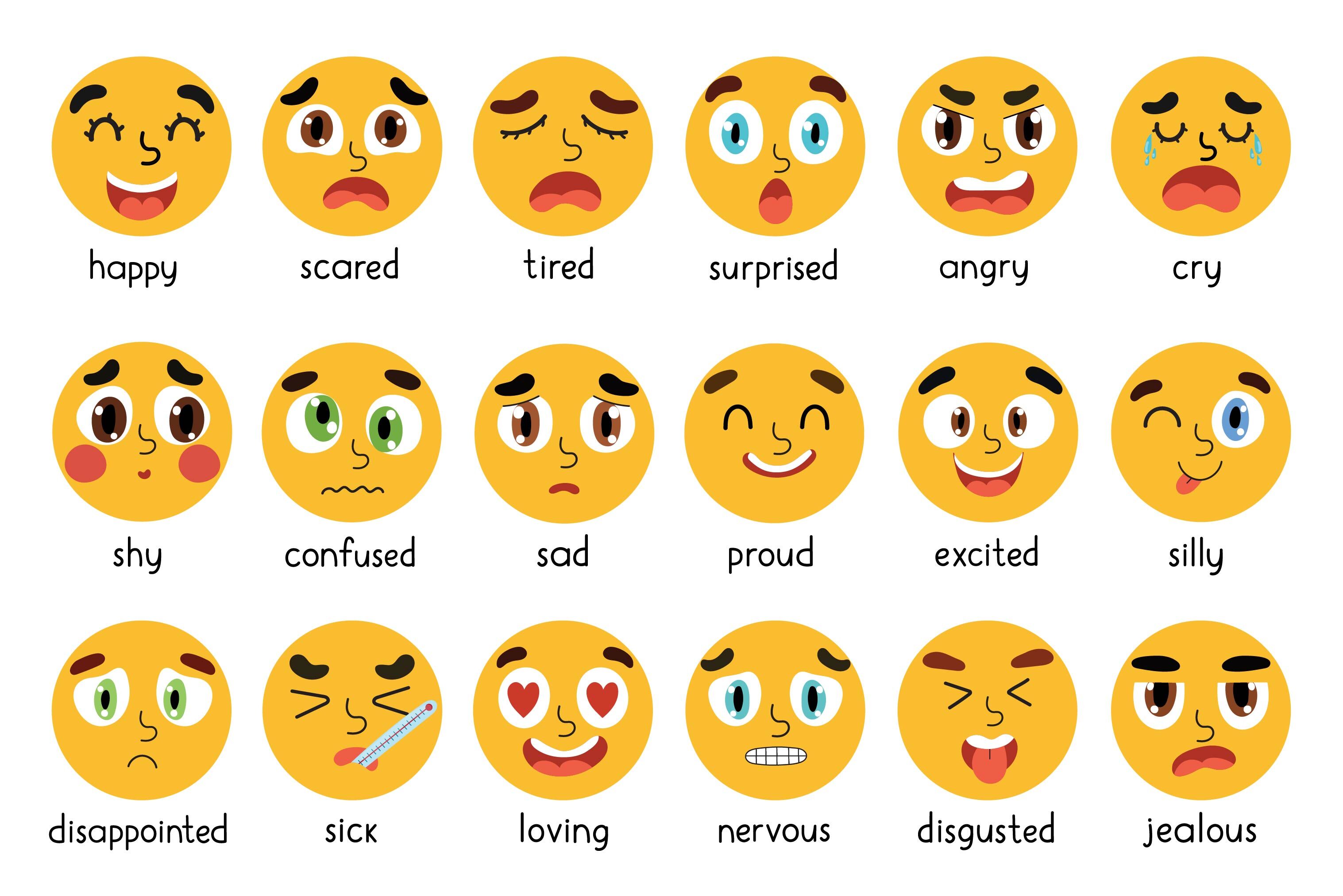
I work at a group practice in Liberty, Missouri, and we have some wonderful counselors. The ones who see children often use pictures like the one above to help kids identify what they’re feeling that day. Honestly, we need this as adults. How we manage and portray our emotions often dictates how well our words land with the person we’re talking to.
Managing our emotions can be difficult for most of us. When I work with couples and we talk about talking and responding, we also talk about what happens when emotions start escalating. Sadly, I’ve seen this unfold in session. A meeting may start off calm, both partners in a good mood, but when certain topics are broached, emotions that sit just below the surface can rise quickly. It might take only a minute. Once those hard emotions — anger, frustration, hurt — come out, the conversation, and sometimes the entire session, can be lost. Productivity disappears. Clarity evaporates.
Some clients shut down. Some cry. Some just walk out of the session and I question whether I’ll see them again. Even seasoned counselors might have difficulty descalating the situation. Many of us don’t think through our emotions, and when that time‑bomb of feelings explodes, the reaction goes critical. Then this guy takes over.

The Rescue Plan
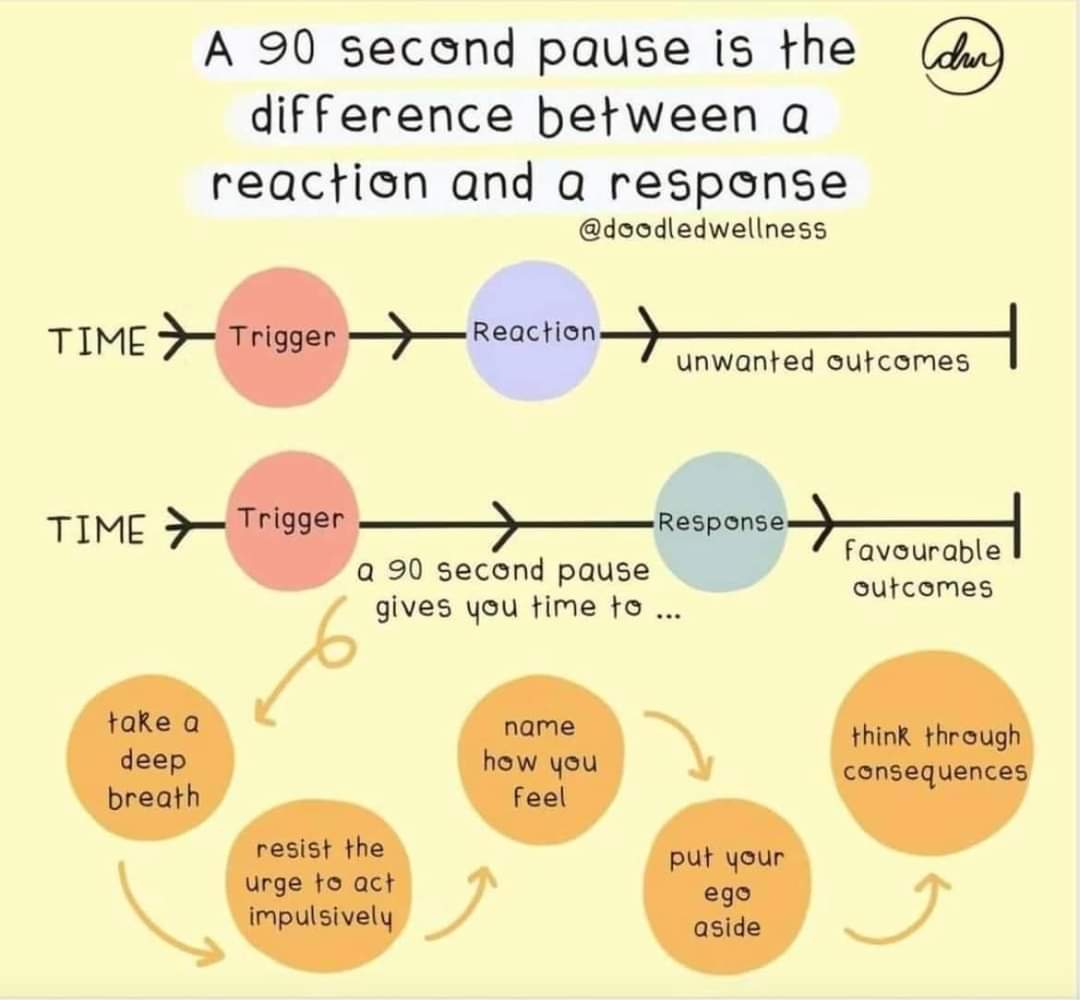
So how can we avoid World War III in our marriages and relationships? It comes down to learning when to de‑escalate and learning how to pause. The pause is so important. It’s the deep breath. It’s owning your feelings without unleashing them in full. It’s the moment where you choose wisdom over reaction.
Below is an illustration I show to many of my clients about the difference between pausing and reacting. When we pause, we allow the cognitive side of our brain to take charge. We slow down. We think. We choose. And the outcomes are almost always more favorable.
But when we react, our emotions take the wheel. The cognitive side — the part that helps us reason, stay grounded, and talk things out — disappears. It’s not that it’s gone forever; it’s just offline. The outcomes then are often unwanted and unwelcomed. Emotion and cognition don’t coexist well when we’re flooded. One pushes the other out.
Look at what happens when we give ourselves a chance to slow down — when we break from the intensity instead of feeding it. Sometimes that means taking a time‑out. We usually think of time‑out as something for children, a place where they can calm down and reflect on their actions. The experts will tell you it’s meant to lower the emotional intensity of the child.
But honestly, I think time‑out is really for the parent.
If my child refuses to pick up their room and I’ve asked ten times, I’m the one about to burst. I’m the one whose emotions are climbing. I’m the one who needs to step away and cool down so that whatever discipline I give isn’t delivered from a place of anger. Time‑out is emotional regulation disguised as parenting.
So why can’t we do the same thing in our marriages and significant relationships?
Taking a time‑out — a pre‑decided, agreed‑upon pause — can slow everything down and prevent World War III or Anger from taking over the control panel. It doesn’t mean disappearing for days or giving the silent treatment. I encourage couples to take a pause for 30–60 minutes. During that time, do something that cools your emotional temperature: take a cold shower, go for a walk, sit somewhere quiet and think about your part and your reaction.
Then come back and talk — but this time more calmly, more rationally, and more connected.
Remember earlier when we talked about tone? Tone becomes harsh when emotions aren’t managed. But when we pause — when we pray, meditate, breathe, or do something that slows the mind and heart — the next conversation has a far better chance of succeeding.
These two parts of The Two Halves of Communicating have been about showing — and giving — your charge to fight for your marriage and for your partner, not at them. The illustrations and principles in this duet of pieces can help create the essentials of a marriage marked by peace and understanding.
Love over hate.
Curiosity over fixing.
Expressing over criticizing.
Listening over correcting.
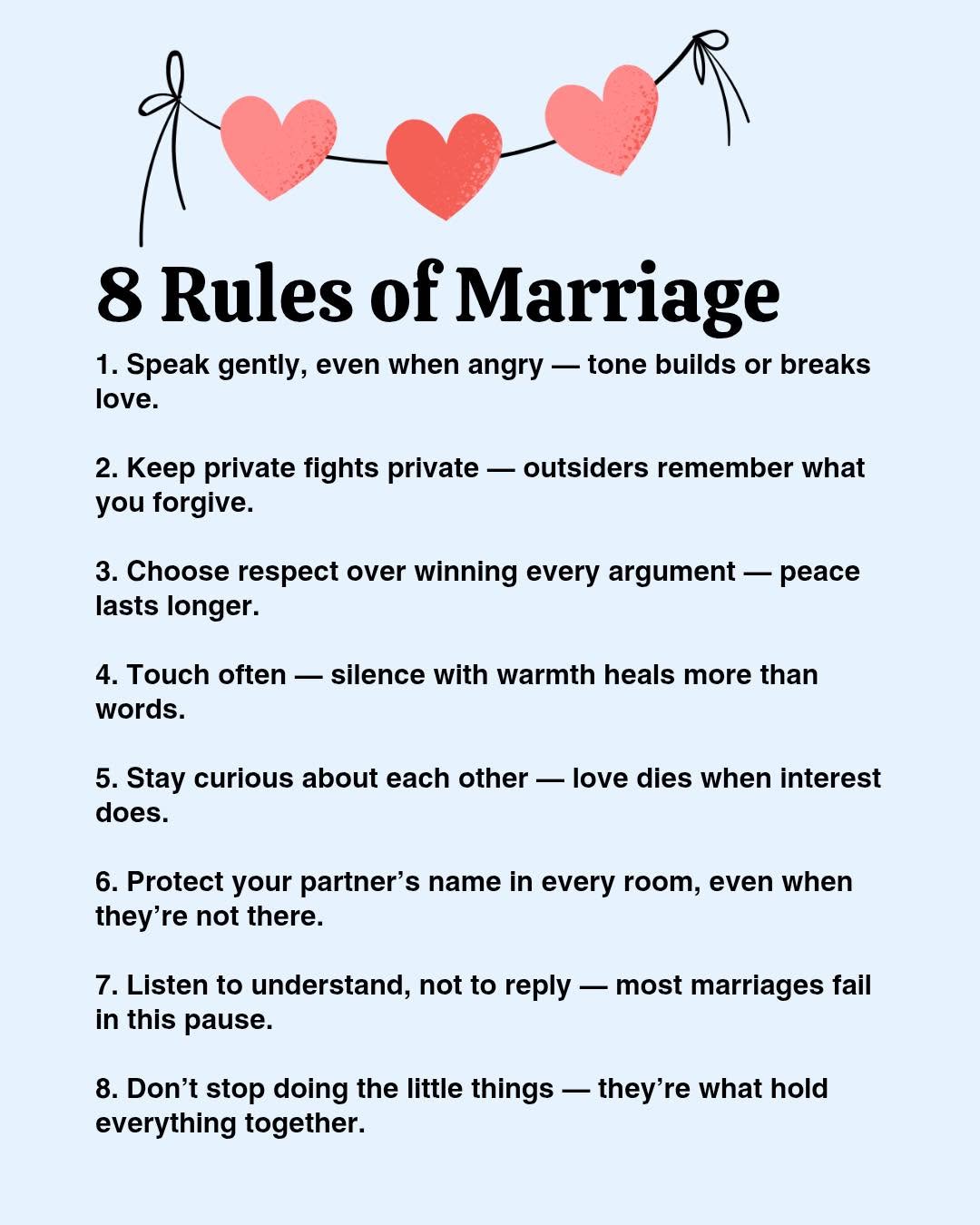
Thank you for reading. I don’t have the next article fully planned yet, but I do have an idea — and a person in mind to help write it: my daughter. The pieces I wrote with her on my former blog drew some of the highest engagement I ever had. Until then, may your journey lead you into peace, love, and grace. Below are some simple rules for marriage — gentle reminders to practice when things get difficult.


Leave a Reply