Hello. I promised a remastered story from my former blog, and here it is. Today we’re taking a fresh look at hope — something many of us feel short on these days.
It’s easy to see why. Division at home and abroad. The constant noise of politics and the frustration of choosing between candidates who don’t feel like the best options. Concerns about the environment. Rising costs and wondering how far the economy will stretch. The ongoing struggles with addiction, anxiety, depression and a host of other challenges that touch families everywhere.
And yet, hope is still present. It hasn’t disappeared. Sometimes we just have to slow down long enough to look for it — and listen for it.
“Returning to the Page”
Before I started writing my book earlier this year, It’s been a while since I last sat down to write. Life has added a few more gray hairs and more than a few detours, and somewhere along the way my momentum slipped. The writer’s block wasn’t dramatic — just long. But I’ve missed having a place to reflect, to sort through what life has been teaching me, and to share pieces of that journey with anyone who finds their way here.
If you’re new, welcome. If you’ve read my earlier work, thanks for coming back.
When I first wrote this piece in late 2022, I was talking with someone about why we write at all. Sometimes it’s simply to share. Sometimes it’s to pass along whatever wisdom we’ve gathered through the ups and downs. And sometimes writing becomes a mirror — a reminder that we’ve made it through hard seasons before, which means we can make it through the ones ahead. If you’ve ever thought about sharing your own story, don’t underestimate its value. Your voice might be exactly what someone else needs. It might even be what you need.
I was 55 when I originally drafted this, inching toward 56. The blog itself began back in 2014, sparked by a young woman’s essay about what her father or father figure meant to her. My early hope was to write something that encouraged men, but the blog quickly widened into reflections on faith, counseling, blended family life, and the eclectic mix of interests that make up my world.
Over the years, this space held my experiences as a graduate student, a bonus dad, and a foster parent. It held the vulnerable parts too — depression, burnout, and the sting of being fired from my first counseling job. Those were raw chapters, but I found my way through them.
My counseling career has taken its share of turns, but for several years now I’ve been grateful to work in a group practice here in Kansas City. The pace of that work pulled me away from writing for a while, but stepping back into it feels right. And if I’m going to begin again, it makes sense to start with something we all reach for, especially in difficult seasons:
Hope.
“Why Hope Still Matters”
The last several years have reminded us how deeply we need hope. The stretch from 2020 onward carried more than its share of heaviness — a pandemic, economic strain, political division, global conflict, and a rise in anxiety, anger, addiction, and relational stress. It’s no surprise that many people have struggled to see anything bright ahead.
So where do we find hope when life feels uncertain or overwhelming?
If you know me, you know I look to Jesus as the source of hope — the One who meets us in the middle of whatever we’re facing. Hope isn’t far away; often it’s as close as a quiet prayer. My wife and I walked through our own seasons of grief and physical pain, and there were days when hope felt thin. I see that same struggle in my counseling office. People come in feeling stuck, discouraged, or unsure how to move forward.
During that same period, I dealt with severe nerve pain in my neck and left arm. Pain has a way of draining your outlook. Some days were discouraging, but hope showed up in the form of a chiropractor who understood the issue and treated it effectively. I’m grateful to say the pain is gone. But even after the pain lifted, I found myself facing bursts of depression and anxiety in ways I hadn’t experienced before. As my wife and I have gotten older, she’s dealt with chronic pain of her own — the kind that hides on the surface but intensifies during colder months. It’s pushed us to think seriously about the next steps in our life, including whether a warmer climate might be part of our future. Through all of it, our faith hasn’t diminished. If anything, these hurdles have pressed us to lean more deeply into our relationship with God. Some days that comes easily; other days it’s a deliberate choice
Talking about hope is one thing — defining it is another. When I first wrote this, I asked friends to share what hope meant to them. Their words helped me see how many different ways hope shows up, and how it might speak to whatever you’re facing today.
“How Others Describe Hope”
When I first wrote this piece, I asked a few friends to share what hope meant to them. Their perspectives were simple, honest, and surprisingly grounding.
Ruth offered this: “Hope means having faith in people and in things to come.” A reminder that hope often begins with trust — in God, in others, and in the future we haven’t seen yet.
Liz shared two scriptures that have carried her through difficult seasons: “But those who hope in the Lord will renew their strength. They will soar on wings like eagles; they will run and not grow weary, they will walk and not be faint.” (Isaiah 40:31) And from Philippians 1:6: “Being confident of this, that He who began a good work in you will carry it on to completion until the day of Christ Jesus.” For Liz, hope is the belief that the future can be better than the past — and that while we do our part, the rest rests in God’s hands.
My wife, LeeAnn, added her own reflection: “We often think hope means wishing something good will happen. But in Scripture, hope is a promise — an anticipation of good to come because Jesus said it would. Good or bad, I trust that all things will work according to His goodness and purpose.” Her words have shaped how both of us view hope, especially in seasons when life feels uncertain.
One of my oldest friends, Chris, offered a different angle: “Hope has to be fought for, and it has to be fed. There’s no such thing as passive hope.” Chris has lived with significant health challenges for years, and he’s fought through every one of them. His perspective carries weight. Attitude matters. It’s hard to see hope when negativity or self pity take over. A steady, intentional mindset opens the door for hope, even when struggle remains.
“Words That Lift Us”
If you have days where you feel a bit like I do, sometimes a few well chosen words can help shift your perspective. Even writing about where I was emotionally helped me find my footing again. Maybe these quotes will do the same for you — offering insight, a steadier outlook, or simply a reminder that hope still rises.
“Hope is the one thing that can help us get through the darkest of times.” — Author Unknown
“Hope is being able to see that there is light despite all of the darkness.” — Desmond Tutu
“The new dawn blooms as we free it. For there is always light if only we’re brave enough to see it, if only we’re brave enough to be it.” — Amanda Gorman
“There is some good in this world, and it’s worth fighting for.” — J.R.R. Tolkien
“It’s always something, to know you’ve done the most you could. But don’t leave off hoping, or it’s of no use doing anything. Hope, hope to the last.” — Charles Dickens
“Hope is that thing inside us that insists, despite all the evidence to the contrary, that something better awaits us if we have the courage to reach for it and to work for it and to fight for it.” — Barack Obama
“Three Ways to Move Toward Hope”
Reading about hope is one thing. Finding it when you feel discouraged or pessimistic about the future is something else entirely. Over time — through research, counseling, and watching how people live through difficult seasons — I’ve noticed a few practices that help us reconnect with hope.
1. Remember who is with you, not just what is around you. For those of us who walk in faith, hope begins with remembering that we’re not navigating life alone. I call Him Abba, Jesus, Father God — whatever name you use, the truth is the same: He is with you, for you, and present in every storm. My counseling mentor, Dr. Larry Cornine, who passed some time ago, often reminded me to pay attention to who is with me rather than the chaos around me. His words still steady me. Even as I wrote this section originally, I felt my own discouragement lift. Hope rises when we remember we’re not facing life in our own strength.
2. Plan for action, not inaction. Chris’s words about “fighting for hope” stay with me. Doing nothing rarely helps; it usually increases worry and anxiety. Movement matters. You don’t have to overhaul your life — just take one step. If you try something and it doesn’t work, adjust and try again. I tell my clients that research is a powerful tool; sometimes a simple search or a new idea can break the mental fog. Most of what I’ve learned has come from books, conversations, videos, and the experiences of others. Hope grows when we participate in our own healing.
3. Don’t go through this alone. Community is one of the strongest antidotes to hopelessness. Sometimes that means one trusted person — a friend, family member, counselor, or mentor. Sometimes it means a group. I’ve been connected to a group of men for more than thirty years. We met in our twenties at a church singles group, and over the decades we’ve watched each other marry, raise families, and walk through hard seasons. For years we met every few months for game nights. Then during the pandemic, my friend Nick reached out and asked if we could meet more intentionally. We all agreed, and several years later, we are still meeting. . Those conversations have deepened our friendships and carried each of us through emotional moments. We joke, we pray, and we show up for one another. They are my brothers in faith, each bringing different strengths and growth areas to the table. I’m deeply grateful for them. Below is a picture of most of us and our wives at a pool party last year.
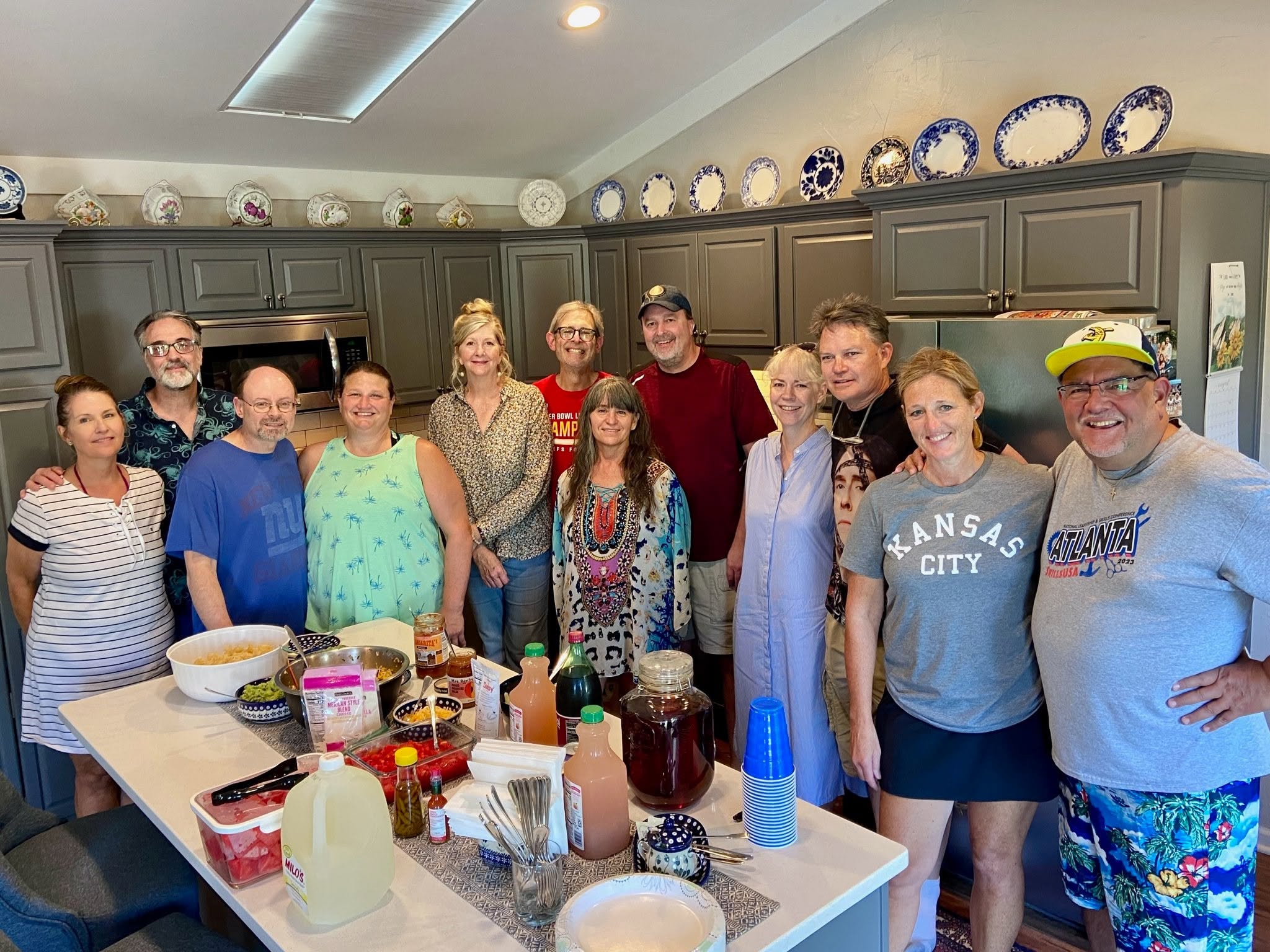
“Finding Hope Through Community”
I’m also involved in Celebrate Recovery, along with a few interest groups and the time my wife and I invest at Life Church. Those communities have been steady places for us — reminders that hope grows best when we’re connected to others.
What about you? Do you have people in your life who walk with you, encourage you, or simply sit with you when things feel heavy? If you’re struggling and feel alone, there are more options than most people realize. Interest groups, online communities, support groups, and churches all offer spaces where people gather around shared experiences. There’s a group for almost every need — grief support like GriefShare, recovery groups, divorce support, and countless others.
The challenge is often not availability, but willingness. If past hurt, trust issues, or fear have kept you distant, community may feel risky. But healing rarely happens in isolation. Working through those barriers — even slowly — opens the door to connection, and connection opens the door to hope.
Hope doesn’t erase the hard parts of life, but it does give us something solid to hold onto as we move through them. As I look back on the seasons that shaped this remastered piece, I’m reminded that hope rarely arrives all at once. It grows through faith, action, and the people who walk beside us. My prayer is that wherever you find yourself today, you’ll notice even a small glimmer of hope rising — enough to take the next step, enough to believe that more is possible.
Next time, I’m looking at doing some writing on my relationship with something that has a growing impact on our life. Artificial Intelligence. Have a great week and keep fighting to find Hope!
Michael French
 Journey Into
Leave a comment