When Warfare Hits us.
By Michael French, MA, LPC
First Reflections
Hello and welcome back to Journey Into. Last time, I shared that I was working on an interview piece with my daughter. That project is still in the pipeline and, hopefully, will be released in the near future.
For today’s post, I’ve been thinking quite a bit about war, especially spiritual warfare, and how it impacts both us and those around us.
I’m writing this on Halloween, October 31, 2026. Today is my Christian birthday. On October 31, 1979, I asked Jesus into my life. I was a seventh grader, twelve years old, and had no idea how significant that day would become.
A few things stand out when I think back to that day. First, I had just flunked my first social studies quiz. Second, it was the last time I ever went trick-or-treating. I was dressed as a firefighter, wearing a yellow raincoat and a bulky plastic fire helmet with a flashing siren on top. At twelve years old, I didn’t realize that chapter of childhood was coming to a close.
There was one other significant event that day.
My friend Darren Barber and his family were going to a Halloween party at a church in Liberty, Missouri. I wasn’t a member of that church and had never attended before, but somehow I invited myself along. Before the festivities began, the church held a short service. Like many churches of that era, they offered an invitation at the end.
I had always believed in God, but that evening I felt drawn by something… or Someone.
When the invitation was given, I walked forward. Two ministers prayed with me and had me repeat a prayer after them. To be honest, I didn’t fully understand what I had done. I simply knew that something important had happened. It wasn’t dramatic. No lightning bolts, no overwhelming emotions. It was a quiet moment.
But it was a beginning.
By now, you may be wondering what any of this has to do with war.
For me, the answer is simple. The moment I entered into a relationship with Jesus Christ, I stepped into a conflict that had been raging long before I arrived. It is a war that stretches back to the earliest pages of Scripture and continues to this very day.
Before we go there, however, let’s take a short detour.
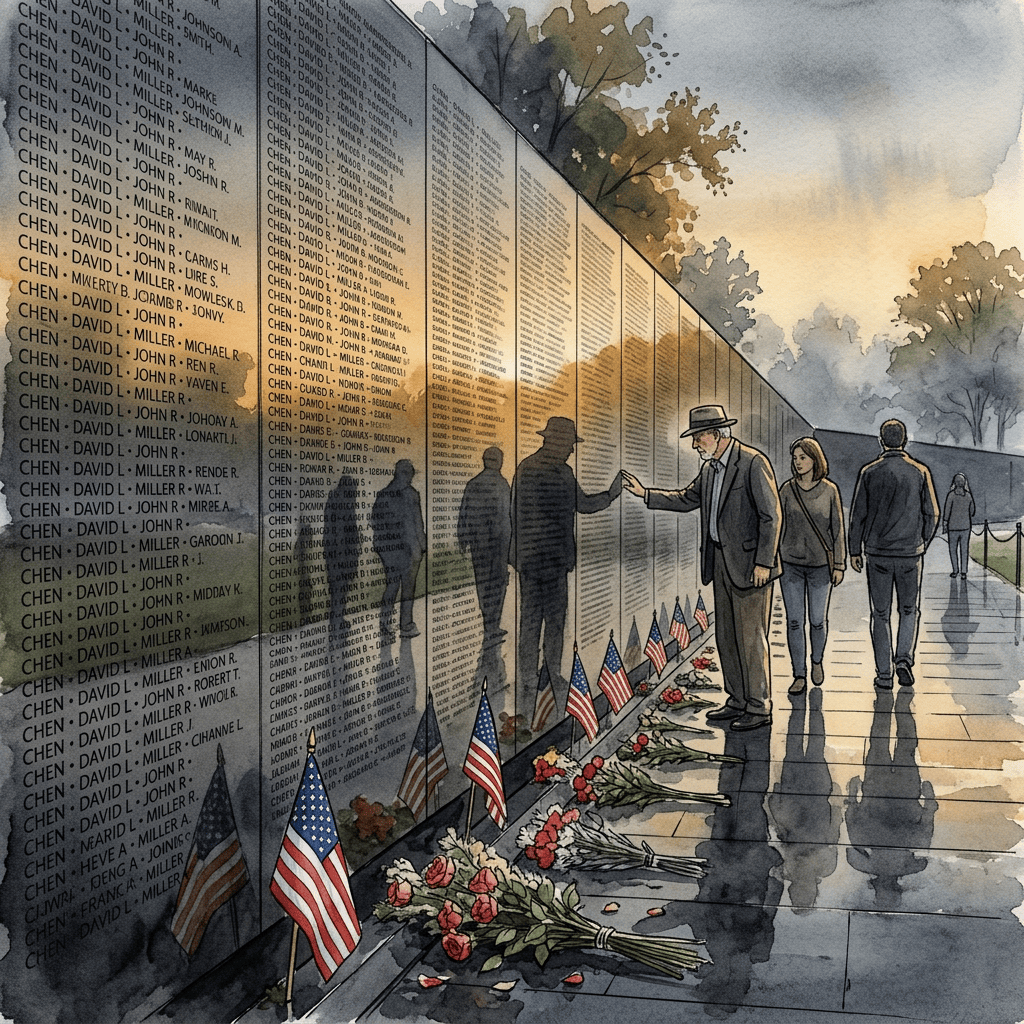
The illustration above is of the Vietnam Veterans Memorial in Washington, D.C. I had the opportunity to visit the memorial more than twenty years ago and have also attended a traveling exhibit featuring a replica of the wall.
Vietnam was America’s most controversial war. It divided the nation and left deep wounds that extended far beyond the battlefield. Many veterans returned home to a reception that was far different from what previous generations had experienced. Some struggled with addiction. Others battled homelessness. Many carried emotional and psychological scars that would later become more widely recognized as post-traumatic stress disorder.
I grew up hearing about the Vietnam War, but as a child I didn’t understand why it was fought or why it affected so many people so deeply. I grew up playing with plastic machine guns that made a clicking sound when the trigger was pulled. The horror and pain of war were unknown to me. I knew only the fun of playing soldier with friends. Perhaps the first war that made an impact on me didn’t occur on Earth but in a galaxy far, far away.
X-Wing Fighter pilots and swingsets.
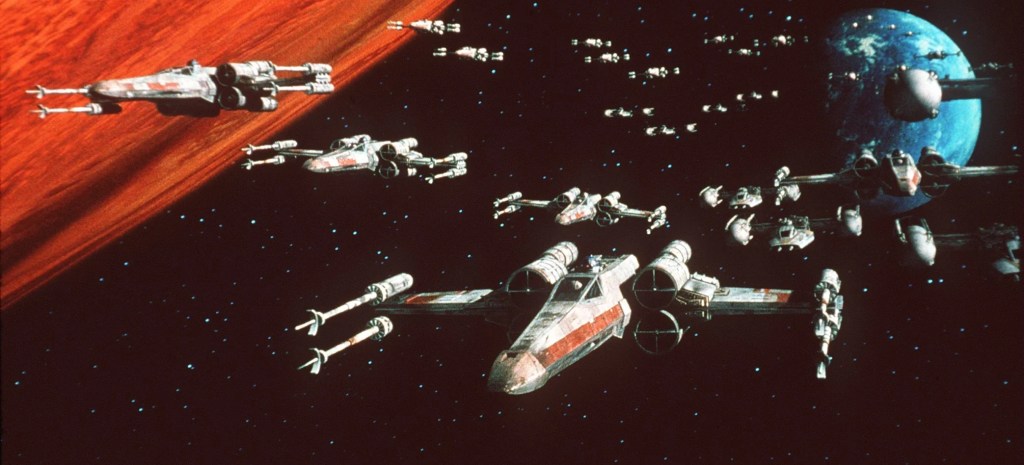
As the picture above suggests, my earliest impressions of war came through the lens of Star Wars. This was war without bloodshed. It was adventure, excitement, and heroism. There were battles, explosions, and narrow escapes, but very little attention was given to the human cost.
There were hints of loss and sacrifice. Princess Leia watched helplessly as her home planet of Alderaan was destroyed. Luke grieved the loss of his mentor, Ben Kenobi, at the hands of Darth Vader, who, unbeknownst to him, would later be revealed as his father.
Yet much of the fighting felt distant from reality. The stormtroopers looked more like faceless machines than human beings. When Alderaan exploded, you didn’t see the countless lives erased in an instant. When the Death Star was destroyed, you didn’t think about the thousands, perhaps even millions, of Imperial personnel who died aboard it. I saw the good guys win without ever considering the cost in human life.
Ironically, in a post-9/11 world, the Rebel Alliance might be viewed differently by some observers. Disney’s masterpiece Andor explored some of those moral complexities, portraying a conflict that was less black-and-white and more shaded in gray. It challenged viewers to think about sacrifice, resistance, and the difficult choices people make during times of war.
But long before the sequels, prequels, and streaming series, I was simply a ten-year-old boy sitting in a movie theater. To me, war was exciting rather than tragic, heroic rather than costly, and far less complicated than it really was.
I’ve shared this story before in my original blog, but I first saw Star Wars with my dad and my best friend Chris. I was ten years old, and Chris was nine. When we got home, we immediately headed for our backyard swing sets. The swings faced one another, and in our imaginations they became the cockpits of Rebel X-Wing fighters. Together we attacked the Death Star and saved the galaxy.
Those were grand times. War seemed epic. Heroes were brave. Villains were obvious. Good always triumphed in the end.
Changing of the Guard.
Slowly, though, the face of war changed as I grew older.
When I was eleven, I met my great-uncle by marriage, James Elliott. Uncle Jimmy was a career Navy officer who had commanded a naval vessel during World War II. He and his wife lived in Coronado, California, near San Diego.
I immediately took to him.
Over the years, Uncle Jimmy became something of a pen pal. His letters to me are a treasure trove of wisdom on faith, life and even girls. He shared stories from his years at sea and even sent me declassified photographs from his service. Some showed naval aircraft landing on carriers. Others showed crash landings on crowded flight decks.
For the first time, war was no longer just spaceships and rebels. It had a human face.
His stories sparked my interest in World War II. As I learned more, I discovered the immense destruction, suffering, and evil that marked that conflict. In seventh grade, our social studies class watched a documentary about the Holocaust that had been filmed shortly after the war ended. Parents were required to sign permission forms before we could view it.
I still remember how sobering it was.
The images left little room for words. This was not the exciting warfare of movies and television. This was humanity at its worst. Since then, I have watched numerous documentaries and films about that period in history, trying to better understand both the courage and the horror that emerged during those years.
Most recently, for the first time, I watched HBO’s acclaimed miniseries Band of Brothers. Like Saving Private Ryan, Schindler’s List, and other portrayals of World War II, it revealed the human cost of war in a deeply personal way.
What struck me most was not the battles themselves.
It was the men.
Their fear. Their exhaustion. Their grief. Their loyalty to one another. Their determination to keep moving forward despite overwhelming circumstances. After the war, some men kept their memories to themselves. Trying to explain the horrors of war to someone who never went through it, became just as difficult as the actual experience. Silent warriors who carried private pain.
This was my dad. He was a Marine who fought in the Korean War and was shot during combat. Three scars in his belly gave him what looked like three belly buttons. He rarely shared what he saw. Usually, some of it only came out when he was drunk. Tears marked those moments, revealing memories he seldom allowed anyone to see.
During my youth, Dad belonged to a group called the Marine Corps League. They met every so often, and he would go. I never really knew what happened at those gatherings, but looking back, I suspect it was more than men getting together for a few drinks. It was a place where veterans could share stories with people who understood. Some burdens are difficult to explain unless you’ve carried them yourself.
In fiction, war often carries an epic grandeur. In reality, war leaves scars.
From Wars on Land to the War of the Soul.
We’re in transition. Through all the wars of history, most have had a beginning and an ending. They were fought by soldiers carrying weapons, but the costs extended far beyond the battlefield. Families suffered. Nations suffered. Lives were forever changed.
Yet there is a war that has never been fought on the beaches of Normandy, in Korea, Vietnam, or a thousand other battlefields throughout history. It has no declaration of war from any nation, and no peace treaty has ever been signed to bring it to an end. No historian can pinpoint the exact beginning of this conflict. Many of its combatants are invisible to human eyes. We cannot see these clashes between good and evil, but we have all felt the effects of the war.
The battle is fought within individuals, families, churches, communities, and nations. It touches our thoughts, our emotions, our relationships, and even our sense of purpose. Some readers may not share my Christian faith, and that’s okay. I simply ask you to consider a few questions.
Why is humanity so drawn toward division, pride, hatred, violence, greed, and destruction? Why does it often seem so difficult to live righteously, take the high road, and do the right thing? Why do we find ourselves struggling not only with circumstances around us, but with battles within us? Could there be something deeper taking place beneath the surface?
For Christians, the Bible provides an answer.
It describes a conflict that existed long before any earthly war. Long before Vietnam. Long before World War II. Long before a boy imagined himself piloting an X-Wing fighter over his backyard swing set.
According to Scripture, the war began with a rebellion. Its origins are often associated with the passage found in Isaiah 14:12-17.
12 King of Babylon, morning star, you have fallen from heaven,
even though you were as bright as the rising sun!
In the past all the nations on earth bowed down before you,
but now you have been cut down.
13 You told yourself,
“I will go up to heaven.
I will put my throne
above God’s stars.
I will sit on the mountain of the gods,
on the slopes of the sacred mountain.
14 I will go up above the tops of the clouds.
I will be like God Most High.”
15 But you were brought down to the grave,
to the deep places where the dead are.
16 Those who see you stare at you.
They think about what has happened to you
and say, “Is this the same man who caused great fear on earth,
who shook the kingdoms,
17 who turned the world into a desert,
who destroyed its cities,
who captured people in war
and would not let them go home?”
I don’t think I fully understood any of this as a youth, but it became more real to me the older I got. While this war may not have begun with humanity, we became participants in it when Adam and Eve ate the fruit in the Garden of Eden. They listened to the Devil, appearing in the form of a serpent, rather than to God Himself. When their disobedience was discovered, they hid in shame, fully aware of what they had done. The Bible teaches that their decision to step outside God’s will brought sin into the world, forever changing the relationship between God and His creation.
If you’d like to go a little deeper into understanding this war, take a few minutes to watch this video from The Bible Project. Using animation and Scripture, it explores the origins of this conflict and the spiritual forces the Bible speaks about. Whether you’re new to the subject or have studied it for years, it may help provide some additional context before we continue.
Adam and Eve experienced some things on that day that are still very familiar to us today. Temptation. Rationalizing our actions. Acting out. Getting caught. Shame. Fear. Blame.
Perhaps these were among the first casualties of the war that entered our world. They are also casualties that many of us continue to struggle with today.
In my fifty-nine-plus years of living, I have certainly experienced my share of all of them. Some snuck up on me. Some I willingly gave in to. Some became wounds that lingered far longer than I expected. Many of us are still grappling with these wounds as we search for healing, understanding, and hope.
Rest from the Battle.
Recently I attended a Wild At Heart’s Survival School mens retreat put on by a local men’s ministry that I’m part of: E6 Ministries. I love going every year. The last several weeks I have felt the effects of this war in terms of internal struggle, dealing with some temptation and also discouragement. In the past, I have written about the name I think God has for me. Resilient Servant Warrior. But lately that warrior has struggled to show up. I was headed to the retreat to tend to the warrior in me.
Over a hundred men from the midwest and even as far as California came to Life Change Camp near Clinton, Mo. Each came with their own struggles and burdens of spiritual warfare. Some came feeling exactly like Adam and Eve felt. Some came like those soldiers of wars past. Wounded, tired, hurting and trying to find meaning. Some men carried harsh burdens from this inner war that impacted their life, work and family.
I remember when I arrived after driving about a 100 miles South of Kansas City. I knew I arrived when I turned onto a gravel road. I really despise gravel roads as it dirties up my car and I have to get to enjoy the feeling of being jostled about. Once I got to the lodge and registered I headed back outside and stood for a moment in the middle of light rain in the woods. The cool of the air. The rain falling on my head. A peace that started to radiate in me. I had this feeling of being home. In a devotion a few years ago, John Eldridge described this feeling as encountering Eden. “Eden was a place of supernatural abundance, for no evil or sin had yet touched it. The presence of God filled the place. The City of God is absolutely a place of supernatural abundance and provision, for the presence of God fills it.”

I wasn’t actually in Eden. I’m not sure Eden would be found near Clinton, Missouri. But it was close. I felt like I had entered a safe place, a place where I could lay my burdens before God and be ministered to.
As I walked to my cabin to unpack, I called out to God and said, “I yield. I yield.”
In many ways, this retreat felt like shore leave.
The war wasn’t over. The struggles waiting for me back home had not magically disappeared. The responsibilities, temptations, disappointments, and challenges of everyday life would still be there when I returned. Yet for a few days, I was given permission to rest.
Standing in those woods, near the pond, I was reminded of the old spiritual:
“I’m gonna lay down my burden, down by the riverside…”
For three and a half days, that’s what I did.
The Call to Surrender
Now this is where things get strange.
Surrender is not encouraged in war. In fact, the fate of those who surrender is often uncertain. Throughout history, captured soldiers have been imprisoned as POWs, tortured, executed, or subjected to conditions most of us can hardly imagine.
Yet surrender is very different when it comes to a relationship with God.
Before the retreat began, I was sitting at a table in our meeting room writing in my notebook. Not knowing what to expect, this is what I wrote:
“Today starts something new. Anticipation is building. I am walking into Survivor School with no knowledge of what will occur.
The last several weeks have been war on my soul and body. And I have been losing. The struggle to keep moving and fighting has been very real, and I keep reclaiming areas that I should have surrendered long ago.
When I attended the previous four boot camps, I had an idea of what to expect. Each boot camp gave me something new to ponder. But this is something different.
So Lord, this weekend I surrender. I surrender all. I hope and pray for some deep root planting that will help me walk and fight more rightly when I return home. When I get back into the war that often feels like there is no end.
Then I signed it with a harsh criticism of myself:
Michael French
Resilient Servant Warrior – Failing There
Looking back at those words, I can see how discouraged I had become.
In my mind, a warrior was supposed to be strong, steady, and victorious. Warriors weren’t supposed to struggle. They weren’t supposed to feel defeated or tired. Yet that was exactly where I found myself.
Perhaps that is one of the greatest misconceptions we have about warfare. The wounded often believe they are failing simply because they are wounded.
The truth is that even good soldiers grow weary. There are times where even best warriors get tired of the fight.
Put on The Armor
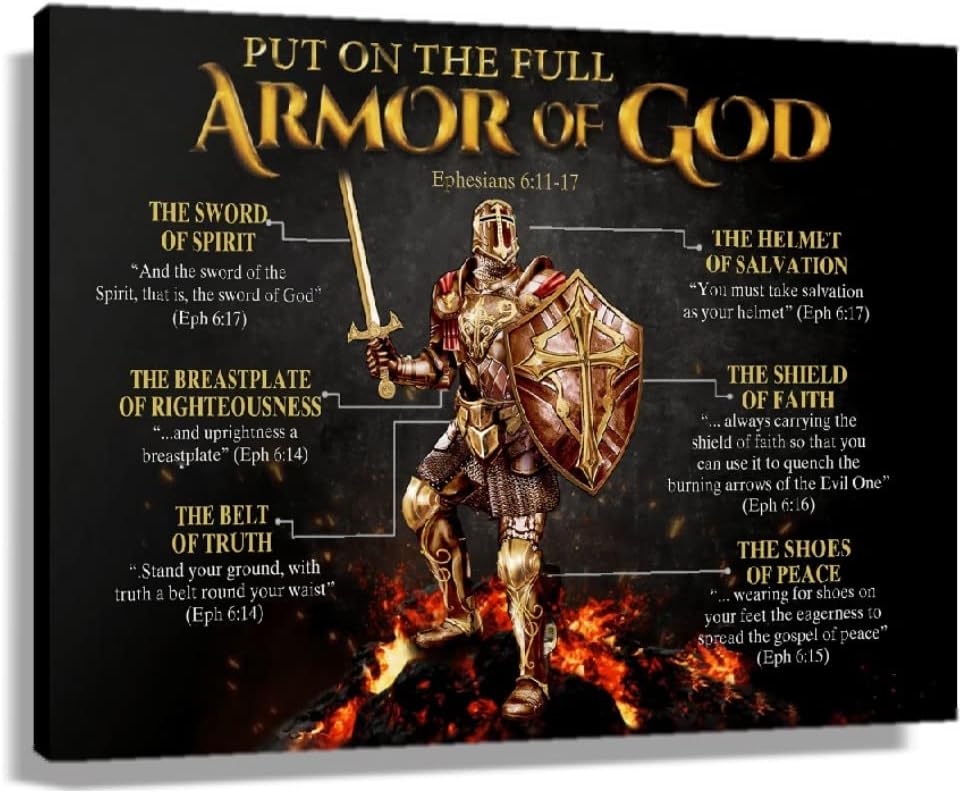
The good thing is that we are not left to fight this battle on our own. I have a statue in my office of this very figure. God may not be handing us an AK-47, a bazooka, a fighter jet, or even the armor of the Mandalorian. Those weapons have no power in the spiritual realm.
Paul tells us to put on the armor of God, though not literally. This armor is internal. It equips us to stand when the enemy sets his sights on us. The shield helps protect us from the countless arrows that come our way. We must remember that the enemy wants us out of the fight, and he will use whatever means he can to accomplish that goal.
Ephesians 6:10-17
10Finally, be strong in the Lord and in His mighty power. 11Put on the full armor of God, so that you can make your stand against the devil’s schemes. 12For our struggle is not against flesh and blood, but against the rulers, against the authorities, against the powers of this world’s darkness, and against the spiritual forces of evil in the heavenly realms.
13Therefore take up the full armor of God, so that when the day of evil comes, you will be able to stand your ground, and having done everything, to stand. 14Stand firm then, with the belt of truth buckled around your waist, with the breastplate of righteousness arrayed, 15and with your feet fitted with the readiness of the gospel of peace. 16In addition to all this, take up the shield of faith, with which you can extinguish all the flaming arrows of the evil one. 17And take the helmet of salvation and the sword of the Spirit, which is the word of God.
However, many of us struggle to put on that armor each day. We may even question whether it really works. At times, we question ourselves and our ability to wield the armor and its weapons effectively.
Part of the challenge is that the enemy rarely attacks with something obviously evil. If temptation appeared ugly from the start, most of us would avoid it. Instead, it often arrives wrapped in something attractive.
Delilah came into Samson’s life. David fell into adultery with Bathsheba. Others throughout history have stumbled over greed, pride, power, or the pursuit of things they believed would finally satisfy them. Temptation often presents itself in a pleasing form, which is what makes the battle so difficult.
The Bible tells us to stand firm in the armor of God and resist the devil. Scripture says he will flee. Not that he might flee. Not that he could flee. He will flee.
The writer of Hebrews tells us that the Word of God is living and active, sharper than any two-edged sword. Yet many of us struggle to use that sword effectively. Perhaps that is why we continue wrestling with many of the same issues that have plagued humanity since the very beginning.
Earlier this year, we were visiting our son Eric in Phoenix, Arizona, where he lives and works. During our visit, he shared some ideas for a book he has been thinking about writing. One of his potential titles immediately caught my attention because I think it fits perfectly here:
“Bake the Damn Cake!”
Okay, what does baking a cake have to do with spiritual warfare?
Quite a bit, actually.
In many ways, “Bake the damn cake” means the same thing as putting on the armor of God.
Stop making excuses. Stop justifying your inaction.
Stop waiting until you feel ready. Do the things God has already called you to do.
But we love giving excuses. Here are a few:
“I’ll start tomorrow.”
“I don’t have time.”
“I’m too tired.”
“I’ll deal with that after things settle down.”
“I’ve failed too many times already.”
“What’s the use? Nothing ever changes.”
“I know what God wants me to do, but I’m not ready.”
“I’ll read my Bible when I feel more motivated.”
“I’ll pray when I can concentrate better.”
“Nobody else struggles with this like I do.”
“This one small compromise won’t matter.”
“I’m not qualified.”
Yet even when it feels difficult to bake the cake or put on the armor, we are not left alone in the fight.
When Jesus left the earth, He promised His followers they would not be abandoned. The Holy Spirit came. In Scripture, He is called the Advocate, Counselor, Comforter, and Helper. He guides us, convicts us, comforts us, strengthens us, and even intercedes for us when we struggle to find the words to pray.
God never intended for us to fight this war by ourselves.
The enemy wants us isolated, discouraged, and convinced that we’re on our own. God continually reminds us that He is present, even in the midst of the battle.
The world has seen countless wars throughout history. Yet perhaps the most important war is the one we cannot easily see. It is fought in our hearts, minds, and souls.
God has not left us defenseless in this conflict. He has given us His Word to guide us, His Spirit to strengthen us, and fellow travelers to walk beside us in the battle.
Above all else, He has given us His Son, Jesus Christ. The Bible tells us that one day Christ will return, restore what has been broken, and finally defeat sin once and for all.
Can you imagine that? A life without sin. A world without shame, fear, blame, temptation, grief, or loss. A world where the war is finally over.
One more video from the Bible Project that talks more about the hope for ending evil.
Until then, we continue the fight. We put on the armor. We bake the cake. We help one another. And we remember that no matter how difficult the battle becomes, the final victory has already been secured. Thanks for taking the time to read and absorb this latest writing on Journey Into. I hope that your journey is leading you into peace, love, and grace.


Leave a Reply